






The Best Concrete for Foundations: A Practical Guide
Choosing the right concrete for a foundation is one of the most consequential decisions in any build. Get it right and you have a structure that will stand strong for generations. Get it wrong and you are looking at cracking, settlement, and costly remediation work before the project is even finished. Yet for many self-builders, developers, and contractors, navigating the world of concrete mixes, strength grades, and site-specific requirements is far from straightforward.
This guide breaks down everything you need to know about selecting the best concrete for foundations, from standard mixes to specialist options, and explains how working with an experienced ready-mixed concrete supplier like us at WM Thompson & Son takes the guesswork out of the process entirely.
Why Foundation Concrete Is Different
Not all concrete is created equal. The concrete used to lay a garden path is a world away from what is required beneath a three-storey house or a commercial building. Foundation concrete must withstand compressive loads, resist moisture ingress, cope with ground movement, and in some cases resist chemical attack from the surrounding soil.
The key performance measure is compressive strength, expressed in the UK as a C-value (for example, C20, C25, C30). This tells you how many newtons per square millimetre the cured concrete can withstand. For foundations, the minimum is generally C20, but the appropriate grade depends heavily on the nature of the build and the ground conditions beneath it.
Common Concrete Mixes and Their Purpose
Understanding concrete mixes and their purpose is the starting point for any sound specification. Here is how the most widely used grades apply to foundation work:
C20 concrete is the lightest mix typically used in residential foundation work. It is suitable for strip foundations on stable ground with low load-bearing requirements. Think small outbuildings, garden walls, or single-storey extensions on firm, non-reactive soil. It offers a good balance of workability and economy.
C25 concrete steps up the strength profile and is one of the most commonly specified mixes for standard house foundations, including strip and trench-fill applications. It handles moderate loads confidently and is appropriate for most domestic builds on stable ground.
C30 concrete is frequently required on more demanding residential and light commercial projects. If ground conditions are variable, soil sulphate levels are elevated, or the structure carries significant loads, C30 is often the minimum the structural engineer will specify. It is also more resistant to freeze-thaw cycles, which matters on exposed sites.
C35 and above moves into reinforced concrete territory. Raft foundations, pile caps, and basement slabs typically demand C35 or higher, often combined with steel reinforcement to control cracking under differential movement.
Beyond strength grades, mix design also accounts for workability (measured by slump), aggregate size, and water-cement ratio. A mix that is too dry is difficult to place and compact properly; one that is too wet loses strength and durability. Getting this balance right on site, particularly for deep trenches or confined pours, is where specialist knowledge pays dividends.
Site-Specific Considerations That Change Everything
Even with the right strength grade selected, site conditions can fundamentally alter what you need in your concrete mix. This is where many projects go wrong.
Sulphate-bearing soils are one of the most common site hazards for foundations. Clay-rich ground, particularly in the Midlands and parts of northern England, often contains naturally occurring sulphates that attack ordinary Portland cement over time. In these conditions, sulphate-resistant cement (SRPC) must be used, and the concrete grade is typically uplifted to C30 or higher. A reputable supplier will ask about your ground investigation results before recommending a mix.
High water tables introduce two problems: the concrete must resist hydrostatic pressure during curing, and the risk of the mix being diluted or washed out during placement increases. In waterlogged conditions, a faster-setting mix or the use of a retarder may be appropriate, and on-site pouring directly from the truck significantly reduces the risk of segregation during placement.
Frost risk is a real concern in the UK, particularly during autumn and spring showers. Concrete that freezes before it reaches sufficient strength will be permanently compromised. A C30 mix with a reduced water-cement ratio offers better resistance, and in colder conditions, admixtures can accelerate the early strength gain.
Reactive clay soils (shrink-swell) require deeper foundations to reach stable ground, and in some cases a more flexible approach to mix design to accommodate minor ground movement without cracking.
This is why a conversation with your concrete supplier before you order matters as much as the order itself.

The Case for Ready-Mixed Concrete
Premixed concrete, or ready-mixed concrete batched at a plant and delivered by truck, is by far the most reliable approach for foundation pours of any significant size. The reasons are straightforward.
Volume consistency is guaranteed. Plant-batched concrete is mixed under controlled conditions with precise proportions every time. The quality control applied at a professional batching plant simply cannot be replicated by mixing on site, particularly when you need several cubic metres of material at a consistent grade.
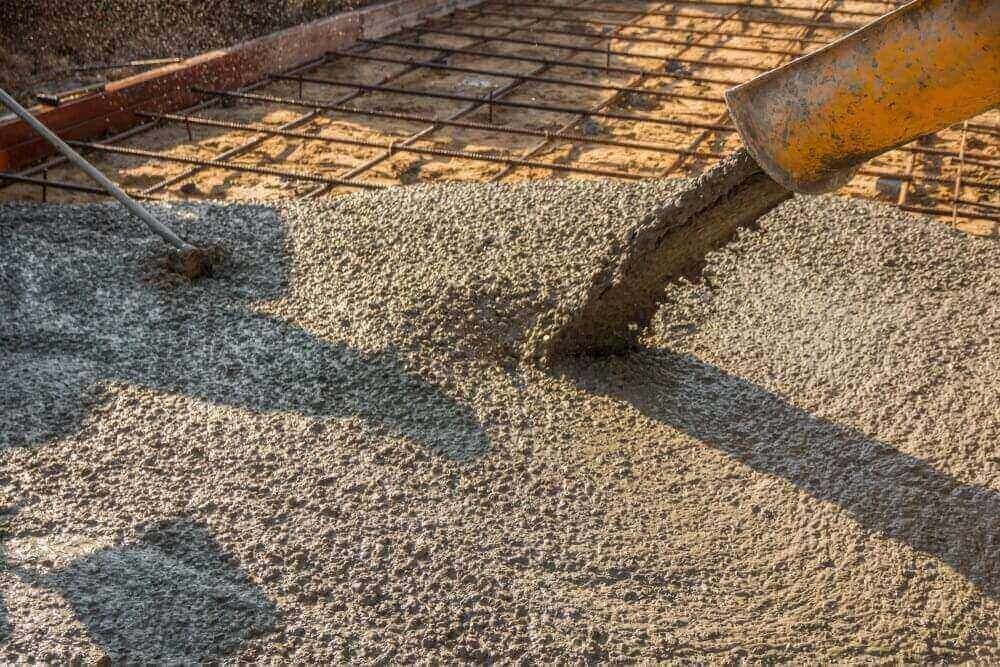
Speed matters for foundations. A large pour needs to be completed without cold joints forming between loads. Ready-mixed concrete, delivered in sequence and poured directly from the chute, allows large volumes to be placed quickly and uniformly, reducing the risk of structural weaknesses.
Compliance is built in. Reputable suppliers batch to BS EN 206 and BS 8500, and can provide full documentation, including delivery tickets that confirm the strength class, cement type, water-cement ratio, and slump. For building control sign-off and structural warranties, this paper trail is increasingly essential.
WM Thompson & Son has been supplying ready-mixed concrete across the region for decades. Our team works with customers from specification through to the pour itself, asking the right questions about ground conditions, structural requirements, and site access to recommend the most appropriate mix for each individual project. On-site pouring support means the concrete lands exactly where it needs to, without the losses and inconsistencies that come with manual handling.
Sustainable Concrete: An Increasingly Important Consideration
Modern construction is under growing pressure to reduce its carbon footprint, and foundation concrete is no exception. Sustainable concrete options have expanded significantly and are now practical rather than niche.
Ground granulated blast-furnace slag (GGBS) is one of the most widely used supplementary cementitious materials. It replaces a proportion of Portland cement in the mix, reducing embodied carbon while actually improving long-term durability and sulphate resistance. Mixes incorporating GGBS are increasingly specified on commercial projects and are becoming more common in residential work.
Pulverised fuel ash (PFA) serves a similar purpose and can also improve workability at lower water content, useful for complex pours.
If sustainability is a priority on your project, ask your supplier about low-carbon mix options. Many ready-mixed concrete producers, including WM Thompson & Son, can advise on how to reduce the carbon impact of your specification without compromising on structural performance.
Getting It Right From the Start
The best concrete for your foundation is not simply the strongest concrete available; it is the concrete that is correctly specified for your ground conditions, structural loads, pour method, and environmental context. Overspecifying wastes money; underspecifying risks the integrity of everything above it.
Working with an experienced ready-mixed concrete supplier removes much of that risk. WM Thompson & Son brings together technical knowledge of concrete mixes and our purposes, local ground-condition experience, and the logistics capability to deliver and pour at volume, so your foundations go in right, first time.
For guidance on the best concrete specification for your project,
get in touch with the team at WM Thompson & Son.